
Consultancy and client relationships are an ever-evolving landscape and sit at the heart of ACE New Zealand’s engagement principles for consultants and clients.
The principles are designed to help guide and enhance consultant and client relationships, engagement practices and behaviours to improve collaboration, efficiency and risk management.
Tonkin + Taylor (T+T) is taking a proactive approach to embedding these principles into its organisational culture through internal workshops, equipping its people with the skills and mindset needed to navigate the complexities of client engagement and project delivery.
We recently sat in on one of its Christchurch workshops and here, with T+T’s permission, we share some of the company’s actionable insights for consultancies seeking to elevate their own training programmes.
Why the principles matter
The workshop addressed a fundamental truth – 90% of engagement issues have nothing to do with technical skills. Respect, trust, and emotional intelligence are as vital as technical expertise, and the real challenges lie in communication, relationships, and the ability to manage difficult conversations.
The principles are practical tools to help foster collaboration, manage risks, and deliver better outcomes for clients, consultants, and the wider community with the goal of building an ethical, sustainable and high performing construction and infrastructure sector.
T+T’s training program is built around the understanding that successful projects depend on strong systems, robust processes, and, most importantly, healthy relationships.
Principles in practice
Applying the principles consistently requires self-awareness and adaptability. They serve as a compass during project challenges and uncertainty, guiding consultants to better outcomes, and are underpinned by three core elements:
- Who makes decisions, and how is information shared?
- How do different stakeholders view the project?
- How do the various relationships involved influence project dynamics?
A successful project requires consideration of the diverse viewpoints of those involved, including the client’s representative, the community and tangata whenua, the client and stakeholders, the consultant and project team, and the consulting company. Relationships to the project can be direct, indirect, or remote, and the principles play a role in each.
Navigating inflection points
Client engagement is dynamic, shifting throughout a project. Consultants must recognise and manage inflection points – moments when the relationship’s direction or tone changes. Their behaviour at these points is critical for building, securing and retaining the client’s trust and maintaining positive engagement.
Change is also inevitable and must be addressed. Discussing change management with clients from the outset sets expectations and reduces friction when adjustments are needed. Key considerations for managing inflection points include:
- Recognising inflection points
- Managing these moments with integrity and trust
- Focusing on the quality of conversations and language used
The human element – listening, reflection and trust
Engineers often default to logic when solving problems, but this alone is insufficient when emotions run high. The ability to ask questions, listen and reflect is essential for building trust and resolving issues. Asking the following questions can help guide responses:
- When is the best time to listen and reflect?
- When should you lean into logic?
Taking a brief pause during challenging meetings can also help consultants collect their thoughts and respond more effectively.
Internal and external application
The principles also apply internally; they are not just for client interactions. Language matters and using the principles to reframe internal conversations can help teams find solutions in challenging situations.
Debriefing with colleagues after client meetings and sharing learnings also helps reinforce the principles and improve future interactions. Engagement is a team effort, and consultants need to support each other.
Key takeaways for training staff
At the end of the workshop, participants reflected upon the discussion and identified actionable insights to personally undertake. Various elements of understanding emerged, reflecting the different personalities and levels of experience in the room. These included:
- Prioritise the human element: focus less on problem-solving and more on listening and reflecting
- Ask questions before offering solutions: create space for understanding before acting
- Practice self-reflection: regularly assess your own approach and impact
- Recognise and manage inflection points: be alert to shifts in engagement and respond thoughtfully
- Model the Principles: senior staff should embody the principles for the benefit of the team and younger staff
- Share reflections: debrief after client meetings and share insights with the team
- Consider all stakeholders: apply the principles broadly, not just to immediate clients
- Manage change proactively: discuss change management with clients early in the project
- Build relationships beyond the client manager: expand your network within client organisations
- Allow time for emotional check-ins: bring a little humanity into internal and external meetings by starting with some space for personal connection
The workshop concluded by emphasising that genuine care is the foundation of effective client management and, despite the complexity of the principles, the greatest challenge lies in making time for self-reflection and ensuring clients feel truly heard and understood.
The principles provide practical tools to strengthen consultant and client engagement and behaviours and serve as a reminder to bring humanity into every interaction.
Find out more about ACE’s six engagement principles for consultants and clients
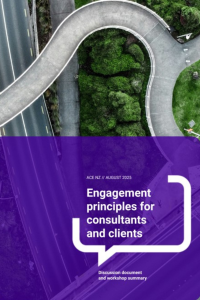 ACE is embarking on a campaign to drive better consultant and client relationships and engagement practices to improve collaboration, efficiencies, and the management of risks, with the goal of improving productivity, time and cost efficiency, outcomes and positive impacts on the economy, society and the environment.
The kaupapa is clear: how can we use our influence to collectively build a more cost-effective and high-performing infrastructure system for Aotearoa?