
Principle one: Engage relationally with integrity and respect
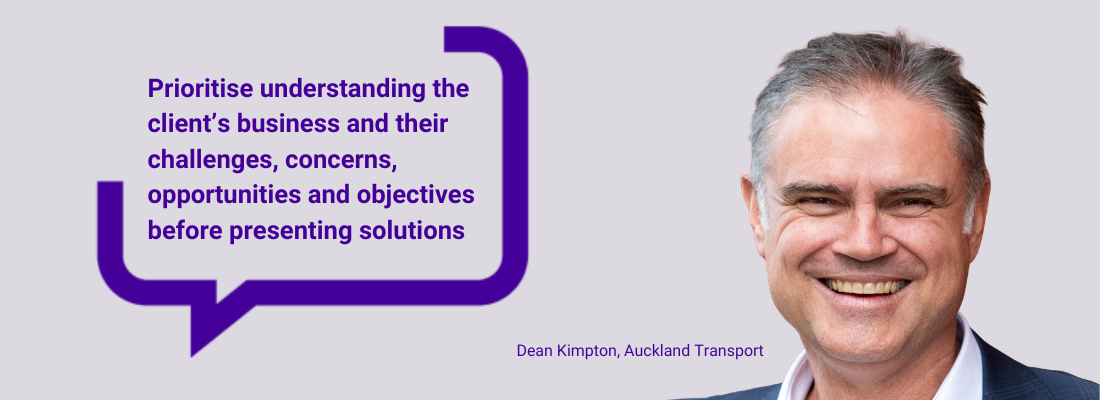
- Prioritise understanding the client’s business, and their challenges, concerns, opportunities, and objectives before presenting solutions. Then the client is more likely to understand your offer and have confidence that it will deliver.
- Avoid assumptions and predetermined offers. Understanding the nuance of what the client is trying to achieve isn’t always found in the tender document.
- Don’t offer a solution to a problem the client doesn’t have. Develop an understanding before positioning.
- Match seniority and expertise appropriately to build relationships and foster trust and confidence. Relationships matter – trust and confidence are built in the relationship and in performance so be thoughtful about how you build those relationships and who is building them.
Principle two: Clarify purpose and outcomes
- Listen and understand to be better aligned with the project or service offer, purpose and outcomes. Bring your own ideas and experiences on what has and hasn’t worked as part of that conversation.
- Maintain contact. This is critical during offer development and following commissioning to ensure solutions remain relevant to deliver the desired outcome. Change is also inevitable, so being prepared to adjust is important if you are to remain on point. Ongoing clarification or checking in on purpose and outcomes is essential over the project lifecycle.
- Be courageous. Inform the client when desired outcomes or outputs are at risk or will not be achieved. Have options and a recommendation to address. Be clear on ‘why’ this has occurred and ‘what’ is best done about it. Escalate early and continue to clarify during the project, because, particularly during larger and complex programmes of work, understanding naturally evolves.
- Understand how your client’s performance is measured or incentivised, and reflect this in your offer of service. These are broader than just project KPIs; also consider their business KPIs.
Examples from an Auckland Transport perspective
- If the client is measured on diversity in procurement, such as use of local labour and resources, tell them how you’ll help them achieve that outcome in the offer.
- If the client is measured on the reduction of average travel times on arterial roads, tell them how you’ll ensure that traffic won’t be slowed down in your methodology.
- If the client is measured on the growth of public transport, tell them how your offer will contribute to this.
- If the client is adding an extra lane to a road to increase capacity and is measured by average travel time, tell them how you’ll keep the remaining lanes open and operating while this additional lane is built.
Principle three: Ensure strong governance, leadership and decision-making
- Understand and acknowledge the complexity of client-side governance, especially in public sector projects, and design your approach to accommodate multiple stakeholders and decision-makers. All require information at different times, either to inform or for decision-making purposes.
- Build engagement, communication, and decision-making into the project programme. This is no different to any other element of the design and delivery process but is often overlooked or under-estimated. Consultants and contractors also have their own governance needs, whether a single team or a blended team with different partners. Understand what each other’s needs are, plan for it, and put it in the programme. Don’t underestimate it. Be courageous. Ensure you’re hitting the programme scope, costs, and outcomes as agreed, but call out if something needs addressing as the project progresses. Notify something in flight, not at the end of the contract, to give the client the opportunity to respond to and manage any changes. As the funder or procurer, the client is entitled to determine the appropriate course of action.
- Plan. Have an approach that allows for evolving programme leadership and governance, especially in more complex programmes of work, and communicate changes proactively to enable effective client management. For example, at the beginning of a large complex programme of work, the director is often skilled in consenting, stakeholder relationships, funding, and getting the programme scoped and positioned. As the programme of work progresses into detailed design and delivery phases, skills often change, and a different programme director may suit.
Principle four: Balance risk while creating the conditions for innovation
- Consider client risks and risk appetite, including cost, quality, business, and reputation.
- Create the environment for innovation and delivery and view it through a risk and opportunity lens. Innovation done well is planned early with proof of concept and implementation strategy, and great discipline in delivery. This is particularly important for public agencies where risk appetite is typically low. Great innovations enhancing delivery and performance are there to be had – being thoughtful about the opportunity and risks that need to be managed enhances the chances of success.
- Reduce reputational risk (for example, through adverse media or social media content) by keeping funders, stakeholders, and the community informed and engaged throughout the innovative approach or project. Get this right, deliver the project efficiently, and you’ll also manage the client’s business and reputational risks.
Examples from an Auckland Transport perspective
- When accelerating physical works delivery during the build phase, outline how you will ensure the project stays on track, deliver the client’s desired business outcome, and manage reputational risk. A project time / cost saving without great communication with the affected public can often end up costing significantly more.
- Auckland Transport is trialing four new New Zealand designed and built electric and electric hybrid ferries. This is a leading technology combination, including landside charging infrastructure. Proving this is not only about sea trials but in-service performance, learning and adapting, and then applying those lessons to the broader electrification objective for our future ferry fleet.
Principle five: Expect change and plan for it
- Change is inevitable.
- High performing teams will lean into change and solve the problem by collaborating with clients to address challenges. They will treat problems as shared responsibilities and proactively seek solutions.
Principle six: Communicate transparently
- Engage consistently with internal and external stakeholders. Great projects, regardless of size, keep clients and local communities informed. Don’t underestimate how interested people are – even those affected in a minor way will have an opinion.
- People personalise their experience, so tell them what’s going on and when, and keep them informed about progress and decisions. This enhances relationships, builds trust, and reduces reputational risk.
Find out more about ACE’s six engagement principles for consultants and clients
 ACE is embarking on a campaign to drive better consultant and client relationships and engagement practices to improve collaboration, efficiencies, and the management of risks, with the goal of improving productivity, time and cost efficiency, outcomes and positive impacts on the economy, society and the environment.
The kaupapa is clear: how can we use our influence to collectively build a more cost-effective and high-performing infrastructure system for Aotearoa?