The two days were grounded in a powerful opening by Nobel Prize winner Lech Wałęsa and his salient reminder that progress is rarely delivered by individuals acting alone: it’s built through solidarity, shared responsibility and leaders willing to speak up when it matters. His challenge landed as a call for professional courage not party politics, a duty to contribute to public conversation, to defend democratic institutions and to stand alongside others when difficult decisions are needed.
For ACE New Zealand member firms, these global discussions offer a set of leadership moves we can make now to build resilience, sharpen our value proposition and help clients make better infrastructure decisions. Here are the themes I’ve brought back home.
Treat geopolitics as an infrastructure input (not background noise)
One message came through strongly: energy security has become inseparable from national security, and geopolitics now sits inside the infrastructure equation. Energy and national security have now surpassed net zero as the primary focus for many nations. Energy security and defence considerations are driving policy and investment decisions – and we can’t ignore the significance of that shift.
Globally, this is reshaping capital allocation – particularly into energy systems, transmission and grid resilience, and (in some markets) nuclear and hydro. The strongest leaders aren’t attempting to predict the future – they’re building organisations that can read risk early, advise with clarity and adjust delivery when context changes. For New Zealand, this shows up immediately in energy system resilience, supply chain fragility and the increasing scrutiny on critical infrastructure choices.
Upgrade your decision intelligence – and slow down to get the facts right
In the continual jump from crisis to crisis, the temptation is to optimise for speed of response. The better leadership stance is to optimise for quality of information. Speakers emphasised that as trusted fact and science-based professionals, we have real agency to influence. Our challenge is to turn dialogue into productive policy, to clarify misinformation and to bring evidence to the table in ways decision-makers can act on.
That means being cautious about information sources, cross-checking what we rely on, seeking specialist intelligence where warranted, and deliberately widening perspective (including through governance, board composition and connections with our communities). It also means showing up earlier in policy formation – before positions harden – and not waiting until consultation windows are narrow and trade-offs are already constrained.
Keep objectives stable – stay flexible on the pathway
In crisis environments, another recurring leadership challenge is how to avoid being dragged into reactive mode. The strongest guidance was simple: let the organisation’s objectives remain stable even when the route needs to change. Leaders must “insist on strategy” through what they measure, fund, talk about and reward. Done well, strategy becomes a stabilising anchor for your people and a filter for deciding which opportunities (and distractions) to pursue.
Procurement is strategy – move the conversation from compliance to outcomes
A consistent undercurrent was that the way services are bought shapes the outcomes clients get, and that procurement is one of the most practical influence points we have. When procurement is treated mainly as process and compliance, it encourages short-termism: narrow scopes, risk pushed downstream and decisions made too late.
The global push is toward procurement that is strategic and explicit about outcomes – resilience, performance, digital readiness, carbon, certainty – and that creates room for better optioneering and smarter risk-sharing.
For consulting firms, this is not an abstract policy debate – it determines whether we’re valued for judgement and insight, or compressed into commodity production. In a world where consulting spend is being driven down, we need to lean into highest value service provision.
AI is forcing a business model and commercial rethink
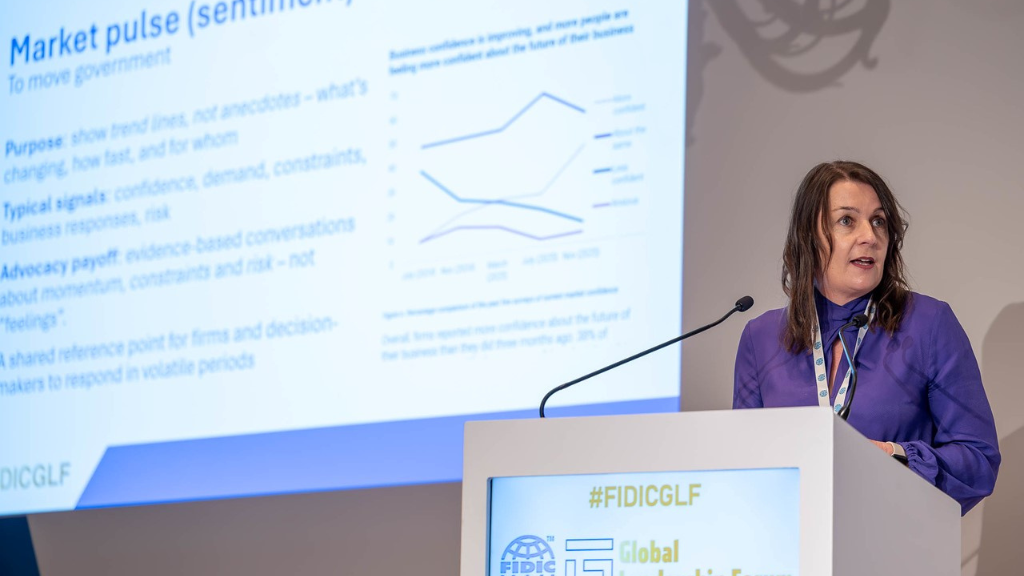
The data point that should make every leadership team pause: 85% of firms say AI is important to success and 87% believe it will enhance job performance and satisfaction – yet only 29% have an AI strategy (and roughly a third have none). That gap matters because AI doesn’t just change how we produce deliverables; it changes what clients will pay for and how quickly some services get commoditised. Within this context, the question is, what does this mean for how we price, staff and structure our firms?
The core shift discussed in Athens is that the “typical” consulting model – selling services through billable hours – doesn’t map neatly to a world where technology can materially compress the time needed for many outputs.
While we’re not yet seeing wholesale change in business models across the sector, we’re increasingly seeing commercial models evolve through digitalisation. The future business model for design and engineering firms is to sell value by bundling expertise with technology and supporting clients beyond design across planning, delivery, assurance, and performance. That requires digital capability, strong QA and governance, and commercial acumen across the organisation.
Workforce is inseparable from this shift. Succession, inclusion and development need to be treated as systems, not ad hoc programmes, and AI should be used to enable people, not replace them, for example reducing low-value churn, lifting consistency, and creating headroom for mentoring, judgement, and client-facing leadership. This is where leaders need to build new value propositions that genuinely transform our firms, rather than layering tools onto yesterday’s structure.
One provocation was that digital readiness should become a condition of financing in the same way environmental and social safeguards already are. If that is where the world is heading, we need to design for AI the way we design for safety: embedded from day one, engineered into data, workflows and assurance, and never treated as optional.
The caution, though, is that as fast as we automate, we must accelerate how we govern and check. Governance is different for AI agents versus agentic AI, with the latter needing stricter controls, defined workflows, and QA. AI doesn’t remove complexity – it shifts it, with the bottleneck moving into assurance. In practice, that moves engineering roles from trusted advisor to trusted interpreter, combining professional accountability with machine-enabled pace.
Climate action still underpins competitiveness – so lead it with business discipline
Decarbonisation is not a side programme – it affects talent attraction, risk, social licence and long-term profitability. The core leadership expectations here are to move your business beyond sustainability initiatives to ownership and influence.
Ownership means that carbon management cannot sit with a small group of internal experts – leaders across the firm need to understand what it means for services, quality, risk and client outcomes and drive this imperative from the top.
Influence means bringing carbon into conversations earlier, and before finance is committed and decisions are locked in. That requires consistency at an organisational level (not just in isolated pockets), while also deliberately building pockets of capability so carbon-informed optioneering becomes part of how we work.
Across all these themes – geopolitics, decision intelligence, commercial resilience, AI and carbon – the common thread is leadership discipline: staying anchored on outcomes while modernising the systems, data and governance that deliver them. The tension is real: clients want lower fees, higher assurance and faster delivery. AI will not make that easier unless our competency, governance, commercial and business models evolve alongside the tools.
Wałęsa’s message adds a final edge: solidarity is a leadership practice. If we want better infrastructure outcomes in New Zealand, our firms can’t stay silent – we need to contribute evidence, choices and trade-offs into the public and policy debate, and we need to do it together.